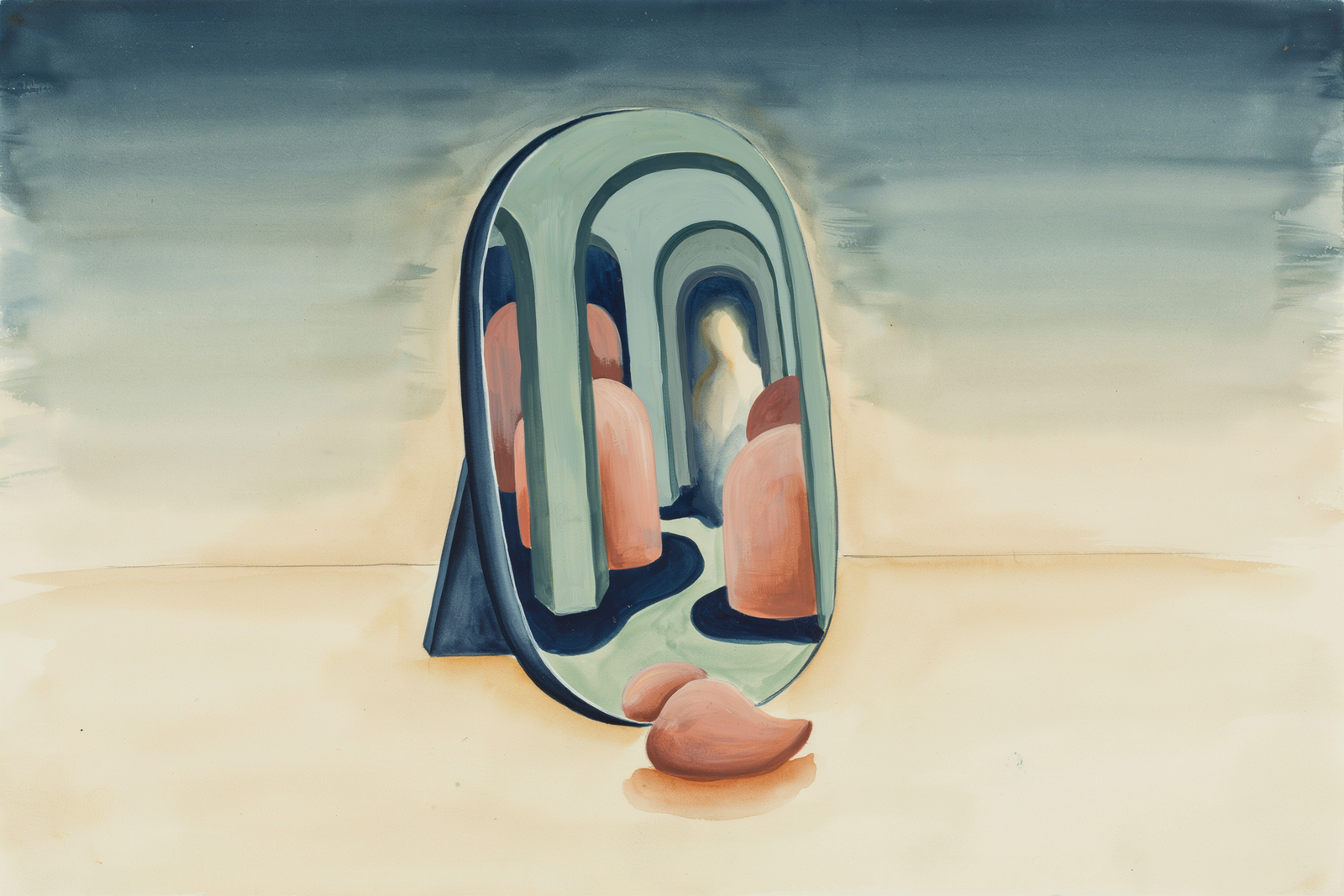
There are two ways people use EIYPO for specific person manifestation, and both of them are wrong.
The first is the control fantasy. If everyone is you pushed out, then the person you want is just a projection of your mind, so you should be able to adjust your inner state and watch them text back, soften, come running. The second is the self-blame spiral. If everyone is you pushed out, then their silence is your consciousness, their distance is your fault, every cold reply is proof that something in you is broken.
Here is what nobody tells you. Those are the same mistake.
Both of them treat the other person as a meter that reports on your state second by second. Both keep your eyes locked on them. And the whole point of the principle is to get your eyes off them. So if EIYPO has you watching someone more closely than before, you have turned a mirror into a microscope, and you are pointing it the wrong direction.
Let me walk through what the principle actually says, and then what you actually do with it.
What "pushed out" really means
The phrase "everyone is you pushed out" is a community shorthand for an idea that runs all through Neville Goddard's work. He taught that the outer world reflects your inner state, that the people in your life behave according to the self-concept and the assumptions you hold. The world, in his framing, is yourself expressed. You can find this mirror theme across his lectures and in books like The Law and the Promise and Awakened Imagination.
Notice the word people skip. Pushed out.
It describes a direction of flow. Something already accepted on the inside becomes visible on the outside. It is not a button you press on another human being. You do not push the person. Your settled inner state expresses itself as a world, and that world happens to include them.
This is the difference that changes everything. The control reading imagines you reaching out and rearranging someone. The actual principle is quieter and, honestly, less flattering to the ego. You are not moving them around. You are living from a state, and they are part of the scenery that state produces.
So the question is never "how do I push them." The question is "what state am I actually in."
The free will question you can drop
A lot of readers get stuck here. They want to know whether the specific person "really" has free will, or whether they are truly just a projection. People argue about this for hours.
I would set it down. Not because it is unimportant, but because it changes nothing about what you do.
Take the strongest possible projection reading, the most hardcore "they have no independent will" position. Even then, the only thing available to you is your own state. You still cannot reach into their head and flip a switch. You are still left with exactly one lever, which is what you assume about yourself. Take the softest reading, where everyone is fully their own person. Same result. You are still left with your own state.
The metaphysics debate ends in the same place no matter who wins. So drop it and go to the place where the work actually is.
Stop reading them. Start noticing who you are being.
Here is the shift that makes EIYPO usable instead of maddening.
Most people apply it as "what am I thinking about him" or "what am I thinking about her." They try to think only positive thoughts about the person, scrub out the doubt, picture them being warm. And it feels like effort because it is effort, the anxious kind.
The more useful read is that the specific person is not mainly reflecting your thoughts about them. They are reflecting your concept of yourself in love. Whether you are someone who gets chosen. Whether you are easy to leave. Whether you are worth staying for. Whether love, for you, is something that arrives or something you have to chase down and earn.
That is the material that gets pushed out.
So the question stops being "what am I thinking about them" and becomes "who am I being while I think about them." Those are different. You can think a hundred sweet thoughts about a person from a self-concept of "I am the one who always gets left." The self-concept wins. It is the louder signal.
This is also where the relief is, if you let it land. You have been trying to manage another human being's feelings from across a distance, which is exhausting and impossible. The principle hands you something smaller and actually within reach. Your own sense of who you are. That, you can work with.
Surveillance is the tell
Want a fast way to know you have inverted the whole thing? Watch your hands.
If EIYPO has you checking their profile, rereading their last message, refreshing for a sign, decoding their behavior for evidence that your state is "working," then you are using a mirror teaching to stare outward. That is the opposite of what it asks. The principle says your state produces the reflection. Checking the reflection to find your state is backwards. You are reading the scoreboard to figure out how you feel, when your feeling is the thing writing the scoreboard.
I will put it bluntly. If a technique increases your urge to check, it is the wrong technique for you right now. If a technique lets you put the phone down, you are closer.
That is the cleanest diagnostic I know. Not "do I feel positive." Just, did this calm the reaching, or feed it.
Responsibility is not blame
Now the painful side. The self-blame reading.
When something does not go your way, EIYPO can curdle into "this is my fault, my consciousness did this, I caused the coldness." That feels like taking responsibility. It usually is not. It is self-focus pointed straight at the wound, and it tends to intensify the monitoring and the desperation, not ease them.
Responsibility in Neville's sense is forward-facing. It is not "what did my consciousness do wrong." It is "what state will I occupy now." The first one keeps you digging through the past for the moment you ruined it. The second one puts the only real tool back in your hands.
You did not break this with a stray thought. Whatever happened, happened. The question that matters is the next one, which is the state you are willing to live from going forward. Blame looks back and shrinks. Responsibility looks ahead and moves.
And wanting the person is allowed. I want to be clear about that, because the SP world loves to tell you that if you still want them, you are "not in the state." That is lazy. Desire is not the problem. The problem is the surveillance and the inner conversation of lack running underneath the desire. Fix those and the wanting can sit there quietly without running your day.
What to actually do
So here is the practice, and it is less cinematic than visualizing them showing up at your door.
Catch your dominant inner conversation about yourself. Not about them. About you, in love. Most people are running something like "he doesn't really care," "she always pulls away," "I'm the one who wants it more." Listen for that line. It repeats more than you think.
Then revise it. Not into a fantasy, into a settled assumption. "I am wanted. Love stays with me. I am easy to choose." Sit with that until it feels less like an affirmation you are arguing for and more like a fact you forgot you knew.
When the urge to check shows up, and it will, use it as a bell. The urge is the signal to come back inward, not to open the app. Feel the pull, name it, and return to who you are being. That is the entire move, repeated.
You are not doing this to operate the other person. You are doing it because the reflection follows the self-concept, never the surveillance.
The actual gift
Here is where EIYPO for specific person manifestation stops being a control panel and becomes something better.
The real payoff is not that you finally seize the remote and make them behave. It is that you get to put the remote down. You stop managing someone else's feelings from a distance. You stop reading their silences like an oracle. You come home to your own state, which is the only thing that was ever yours to tend.
That is freedom, and it is a stranger, steadier thing than control.
You wanted a lever to move them. What you get instead is your attention back. Take it.
