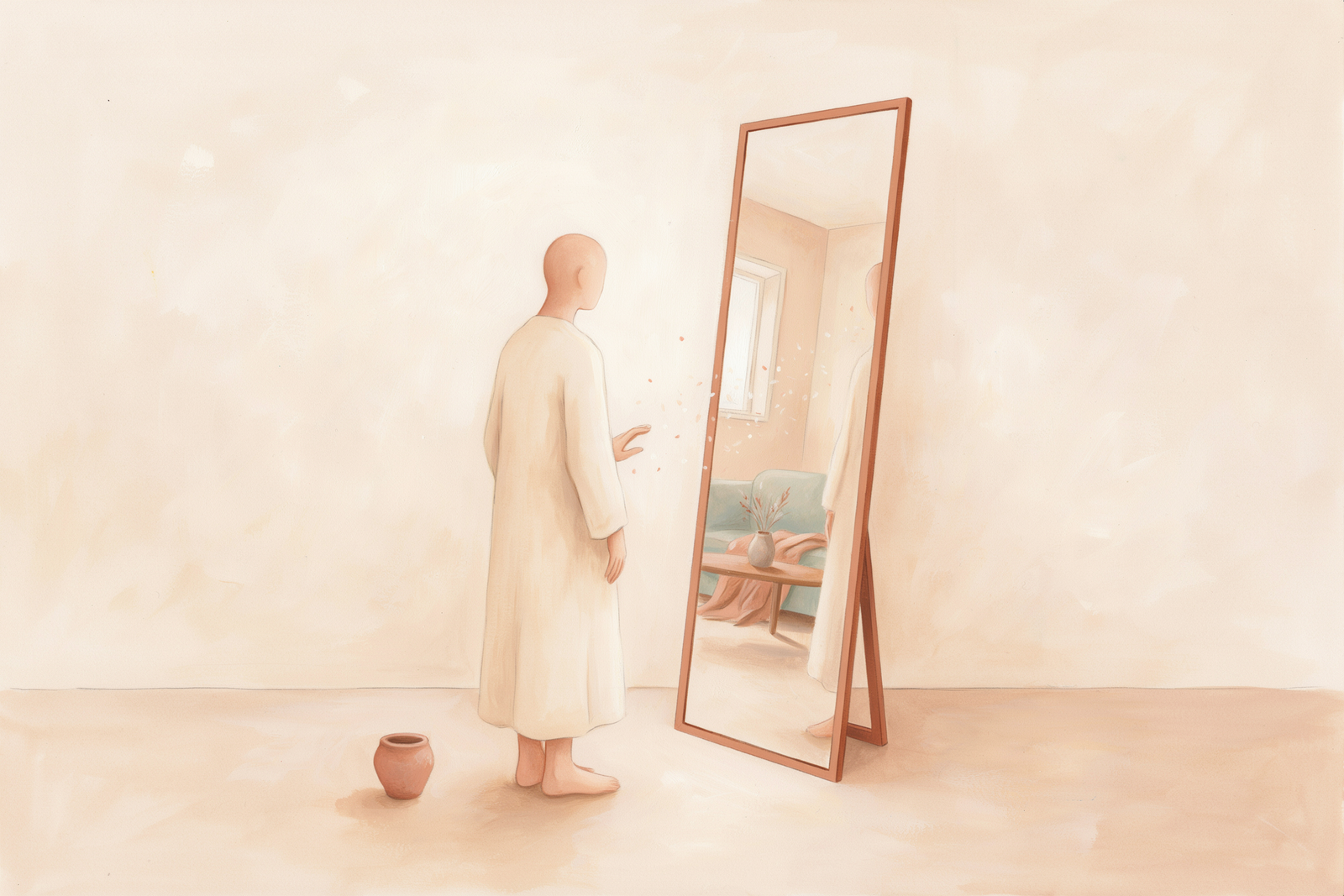
Most people who ask about law of attraction vs law of assumption are not really asking for two definitions. They already have those. They watched the videos. They tried the gratitude lists and the high-vibe mornings, and something quietly did not click. Now they've heard that assumption is the "real" version, and they want to know if switching words will actually change anything.
So let me be direct about it. These are not two rival religions. They come from the same root. But they hand your mind two different instructions, and one of those instructions is cleaner. That's the part worth your time.
The same family, not two enemies
Before I pick a side, I want to kill the drama.
The phrase "law of attraction" is old. It was floating around New Thought writing in the early 1900s, long before The Secret turned it into a household term in 2006. Neville Goddard, who taught what people now call the law of assumption, was writing in the 1940s and 50s out of that same broad current. Both grew from one idea: your inner life shapes your outer life.
So when someone tells you one is fake and one is true, ignore them. They're selling a rivalry that doesn't exist. What does exist is a difference in where each one tells you to stand.
What the law of attraction actually tells you to do
The popular version of the law of attraction is built on a relationship. There's you, over here. There's the thing you want, over there. And somewhere in between is a responsive universe that sends you matches based on your frequency.
The instruction, then, is to become magnetic. Feel good. Be grateful. Raise your vibration. Stay aligned so the thing you want can find its way to you.
There's something true in that, and I won't pretend otherwise. Your emotional state does change how you move through the day. Gratitude does shift what you notice. People who feel steady do tend to act in ways that open doors.
But look closely at the structure of it. The thing is still out there. You're still waiting for delivery. And that setup quietly builds a trap.
Where law of attraction goes sideways
The trap is monitoring.
Once you believe a universe is responding to your frequency, you start checking your frequency. You wake up and take your emotional temperature. You wonder if that flash of doubt cancelled yesterday's good feeling. You watch for signs. You refresh your hope like an inbox.
That's the whole problem. Every time you check whether it's coming, you confirm to yourself that it isn't here yet. You reintroduce the exact gap you were trying to close. The practice becomes surveillance, and surveillance runs on lack.
I've watched people do everything "right" by this model and stay stuck for months, not because they failed at feeling good, but because feeling good became one more chore they had to keep performing to earn the outcome.
What the law of assumption tells you to do instead
Neville's law of assumption removes the distance entirely.
In his framework, there's no outside source shipping you results. Consciousness is the reality. The outer world reflects the state you're actually living in. You don't attract the thing. You assume the version of yourself for whom the thing is already true, and you let the world catch up to that.
The move is subtle but it changes everything. You stop thinking about what you want and start thinking from having it. Neville called this living in the end, and the language matters. The end is the point where it's done. Not hoped for. Done.
So instead of "I hope the money comes," the assumed state is closer to the flat, unbothered feeling of someone who already has it and isn't thinking about it much. Instead of "please let them text back," it's the ease of a person who already knows where they stand.
A commonly repeated summary of his teaching is that an assumption, even one that feels false at first, will harden into fact if you persist in it. I'd treat that as the whole method in one line.
The real difference in one sentence
Law of attraction asks you to generate a feeling to attract a result.
Law of assumption asks you to occupy an identity in which the result is already real.
That's it. One works on mood. The other works on self-concept. And here's my actual opinion after years of watching both in practice: identity is more stable than mood. Your feelings swing by the hour. Who you quietly believe you are does not. Building your practice on the steadier of the two is just better engineering.
But doesn't assumption also use feeling?
Yes, and this trips people up, so let me separate it cleanly.
Both talk about feeling. They don't mean the same thing.
In the attraction model, feeling good is the fuel. It's the thing you produce to power the magnet. In the assumption model, feeling is not fuel. It's confirmation. The feeling you're after is the naturalness of already having it, the way you'd feel about your own name. Not excitement. Not a manufactured high. Just the quiet obviousness of something settled.
If you're straining to feel amazing, you're back in the attraction trap wearing new vocabulary. The assumed state usually feels calmer than that. Almost boring. That boredom is a good sign.
A word about wanting
I want to be careful here, because a lot of teachers get this wrong and it does real damage.
You'll hear that if you still want something, you've proven you don't have it, so you've cancelled it. That's imprecise and a little cruel. Wanting isn't the problem. Everyone who assumes a state started from wanting.
The distinction is where you're standing when you feel the desire. Wanting from lack keeps the thing at arm's length, because lack is a statement that it's missing. Assuming from fulfillment closes the gap, because you've already accepted it as yours. Same desire. Different address.
So don't punish yourself for wanting the outcome. Just stop broadcasting the wanting as an emergency and start treating the having as a settled fact.
Which one should you actually use
If you want my honest recommendation, lean on assumption as your primary instruction and let the useful parts of attraction support it.
Gratitude, steadiness, noticing good things, none of that is wrong. It becomes powerful the moment it stops being a magnet you're operating and starts being evidence of the state you already live in. A grateful person isn't trying to attract. They're just being grateful because, in their world, there's plenty. That's assumption doing the work, with gratitude riding along.
Action fits the same way. The attraction crowd talks about inspired action, waiting for the nudge. Assumption implies something simpler. You act like the person you've decided you are. The behavior changes because the self-concept changed, not because you're doing tasks to bribe the universe.
How to make the switch tomorrow
You don't need a new ritual. You need to move where you're standing.
Pick the thing you've been trying to attract. Notice the posture you've been holding, the reaching, the checking, the hoping it lands. Then drop into the other position and ask a different question. Not "how do I get this," but "who am I once this is normal, and how does that person move through an ordinary Tuesday?"
Then be that, in small ways, today. The tone of your texts. What you assume when your phone buzzes. How you carry a bad hour without deciding it ruined everything.
That's the full mechanics of law of attraction vs law of assumption once you strip the marketing off both. One keeps the thing across the room and asks you to pull it closer. The other closes the room. I'd close the room. It stops the exhausting habit of measuring the distance, and it turns out the distance was mostly something you were maintaining anyway.