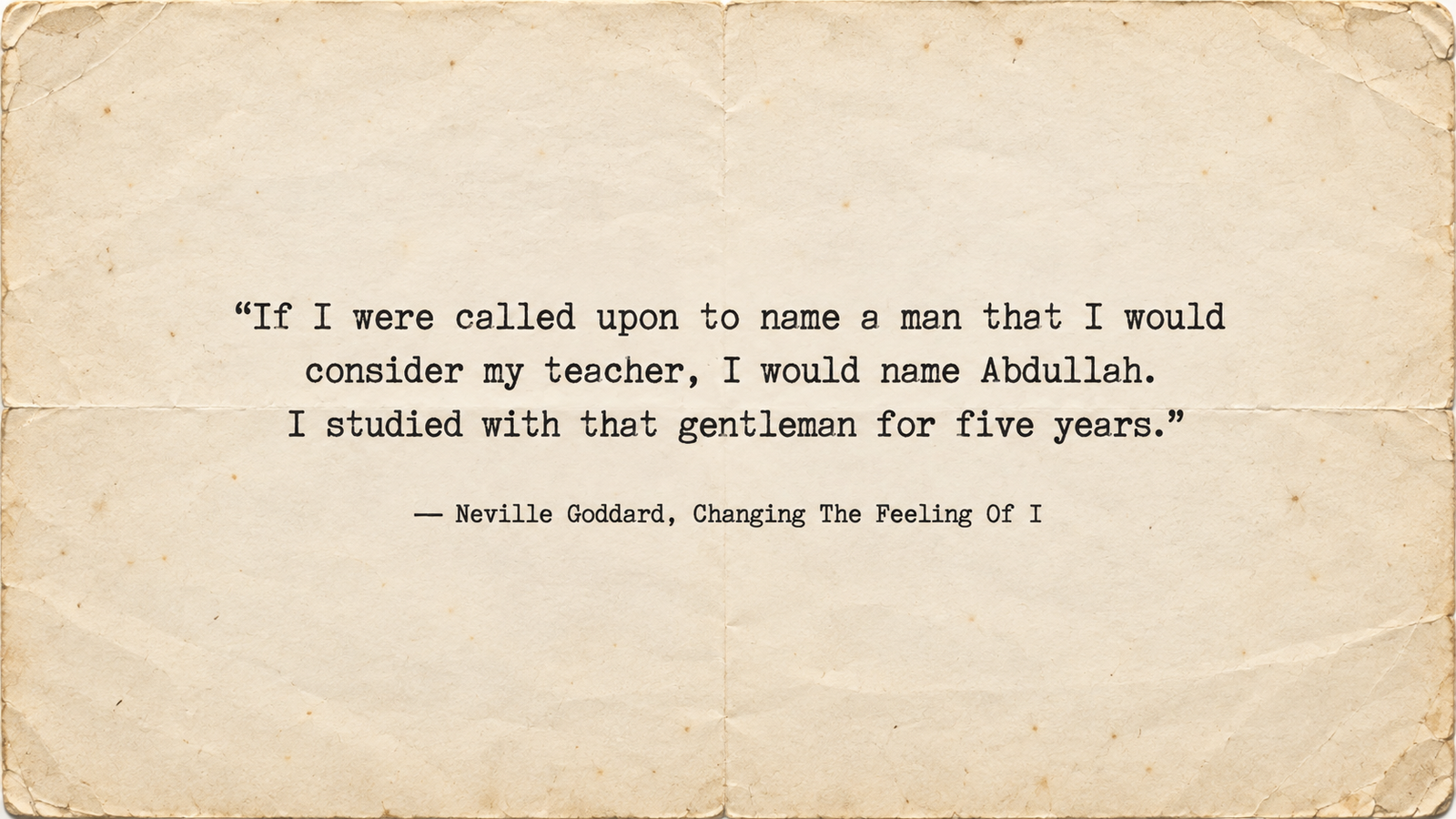
Neville Goddard and Abdullah’s Barbados story always leaves me feeling a little sorry for Neville. He wanted to go home, couldn’t afford the journey, and went to his teacher hoping for help. Abdullah told him he was already there.
You can imagine how helpful that sounded when he still needed a ticket.
Abdullah was Neville Goddard’s spiritual teacher in New York. He taught him Hebrew, Scripture, and the use of imagination, including the approach Neville later became known for as living in the end. Their conversations put some flesh on that phrase. Neville had questions, got impatient, and wanted reassurance. Abdullah had very little interest in giving it.
I like that about this story. There is a person trying to get somewhere in it, with all the uncertainty that involves.
Who Was Abdullah, Neville Goddard’s Teacher?
Abdullah taught Neville Hebrew and spiritual interpretations of Scripture. In Gift Bestowed By God, Neville remembers small gatherings at his home on West 72nd Street and describes how those lessons changed his understanding of imagination. Read the lecture.
You’ll often see him called an Ethiopian rabbi. The traditional biographical account describes him as an Ethiopian Jewish teacher, although parts of his background remain unresolved.
There is now historical research beyond that familiar description. Cool Wisdom Books identifies him with Modeste Abdallah Guillaume, also known by variants of G. Mahmud Ahmad Abdoullah, drawing connections between newspaper notices and the address Neville remembered. If you enjoy the historical side, the address investigation is worth reading.
I find Abdullah’s teaching style easier to grasp than his biography. Through Neville’s recollections, we meet someone who could be blunt, impatient with repeated questions, and completely committed to what he was teaching.
You can see why a conversation with him would stay with you.
The Neville Goddard and Abdullah Barbados Story
It was 1933, and Neville was out of work in New York. He wanted to spend Christmas at home in Barbados, but he had no money for the trip. So he went to Abdullah.
Abdullah’s answer was short.
“You are in Barbados.”
Neville was standing in New York. He could hardly have missed that. Still, he tried to follow the instruction. That night, he imagined sleeping in his mother’s home, with America far away to the north. He let himself experience being home.
Then came the waiting.
After a while, with nothing happening, Neville went back to talk it through. I find this part very easy to sympathise with. You try something, give it some time, and eventually want to ask whether you are even doing it properly.
Abdullah wouldn’t have the discussion. He went into his library and shut the door.
As Neville explains in his later Q&A account, Abdullah saw no reason to discuss how he would reach a place he had already assumed he was in.
I doubt that made the closed door any less irritating at the time.
Then a letter arrived from Neville’s brother Victor. He wanted Neville home for Christmas, had arranged his passage, and enclosed $50 for things he might need for the trip.
Neville went to collect his ticket. There was room, but he would have to sleep third class for part of the journey before moving to first class. He accepted it and went back to Abdullah with the news.
You would think this conversation might go a little better. He was finally going home.
But Abdullah was still talking about a journey already completed. And as far as he was concerned, Neville had travelled first class.
When Neville arrived to board, someone had cancelled. He could travel first class the whole way. That is the ending he gives in his 1948 lesson, Thinking Fourth-Dimensionally.
What I like about the story is how recognisable Neville’s side of it feels. He wanted to trust the instruction, but he also wanted something to happen. I can picture myself doing much the same thing, returning for one more conversation and hoping this time the answer would come with a few practical details.
What Abdullah Taught Neville Goddard About Assumption
So what do you actually do with a story like that? I would start with what Abdullah asked Neville to experience, then look at the habits that make it difficult to stay with an idea once the waiting begins.
Put Yourself Inside the Experience
Neville explains the practice in Assumptions Harden into Fact. You imagine yourself in the desired situation and give yourself the feeling of its fulfilment.
For me, a house makes this easier to picture.
Suppose you want a home of your own. Picture yourself walking past a house you love. You admire the windows, the garden, the front door. It is a pleasant image, but you could have that exact experience while believing you will never live there.
Now imagine coming through the door and putting your keys in the bowl where you always leave them.
You know where the keys go because you live there. The scene places you inside the life you want. There is nothing particularly exciting about putting keys in a bowl, which is partly why I like it.
When choosing an imagined moment, I would pay attention to what it implies. A beautiful picture can still leave you longing. Something as mundane as setting down your shopping can express that you have arrived.
Recognise the Habit of Asking Again
The closed door is the part I keep thinking about. I read it as Abdullah refusing to participate in another round of reassurance.
It is easy to recognise the pattern. You read an explanation and feel settled for a while. The next morning, you want another explanation. Then you look for a success story from someone whose circumstances match yours. Preferably someone who started on the same day and had the same doubts.
At that point, you may have understood the teaching perfectly well. What you want is relief from waiting.
I would ask myself what I expect the next article or video to provide. Is there a specific question I need answered? Or am I hoping to borrow someone else’s confidence for another hour?
Sometimes I think the honest answer would be that I already know what to try. I just want someone to promise it will work before I give it a chance.
Let Fulfilment Feel Ordinary
I think we often make imagined fulfilment unnecessarily theatrical. We build scenes with applause, astonishment, and people finally recognising how well we have done.
I understand the appeal. Who wouldn’t enjoy a little recognition? But most of the life you want will probably happen on fairly ordinary Tuesdays.
If you felt secure in a relationship, much of it might look like deciding what to have for dinner. If you felt confident at work, it might look like answering a question without rehearsing your response three times. If you felt at home somewhere, you might stop noticing the front door altogether.
I like those examples because they make room for familiarity. Having something often feels quieter than wanting it.
That is the kind of detail I would choose for an exercise based on Neville and Abdullah’s teachings. Something I could inhabit easily, without needing to manufacture a dramatic mood.
Why Abdullah’s Teaching Went Beyond Getting a Ticket
Neville’s interest in Abdullah also involved the Bible and the nature of God. In Gift Bestowed By God, he connects human imagination with the divine and describes how experience changed his reading of Scripture. The Barbados journey belonged to that larger change in understanding. Read his explanation.
I think this part gets lost when every Neville story becomes a technique with a promised delivery date.
His lectures ask you to consider what you believe about yourself and where you place creative power. You can disagree with his theology and still understand why it mattered to him. He was working through a view of human identity, faith, and imagination that reached into the rest of his life.
That is why I would spend some time with the lectures if the Law of Assumption interests you. It is easy to get so caught up in choosing a scene before bed that you never get around to the ideas behind it.
How I Would Apply Abdullah’s Lesson
I would start by choosing one desire and asking what an ordinary moment would look like if it were fulfilled.
For example, suppose you want to feel comfortable speaking in a group. Imagine finishing a conversation and realising you said what you meant. You are putting your cup away. The conversation is over, and you feel no need to review every sentence.
Keep the exercise simple.
- Choose the experience you want. Be clear about what fulfilment means to you.
- Find a small moment that implies it. Pick something you can experience from your own point of view.
- Give the moment a little attention. Notice the setting, the action, and the feeling of familiarity.
- Return to your day. Take the next real opportunity to participate, practise, or act.
I would rather work with one clear moment than spend the evening worrying about whether I had assembled a scene correctly. Otherwise, the exercise becomes another thing to feel inadequate about.
Abdullah Quotes From Neville Goddard’s Lectures
The words we associate with Abdullah come to us through Neville. These two lines from the Q&A capture his approach to the Barbados conversation.
“You are in Barbados.”
“You went to Barbados, and you went First Class.”
— Abdullah, as recalled by Neville Goddard in Abdullah How We Got Together Q&A.
I would read the surrounding story before turning either line into an affirmation. The point I take from it is to consider the experience the words describe. Repeating a destination is easy. Imagining yourself living there asks for more attention.
Neville Goddard and Abdullah Books and PDFs
If you want to read more, I would begin with Neville’s lectures. They let you hear how he explained the relationship, with all the personality that a short quote leaves out.
Start with Thinking Fourth-Dimensionally, then read Gift Bestowed By God. The RealNeville PDF archive also provides a directory of downloadable lecture texts.
As for books by Abdullah himself, Cool Wisdom Books reports copyright registrations for works including The Book of Peace under Abdoullah name variants. These belong to its research into Abdullah’s identity, and the researcher is still investigating surviving copies. You can follow that work in the copyright-card research. A modern book about him is a different kind of resource.
What I like about returning to the lectures is that they leave me with something specific to consider. Tonight, if you try the exercise, choose a moment you would barely remark on if your desire were already part of your life. Put the keys down. Finish the conversation. Sit at your own kitchen table.
Give that ordinary moment your attention and see what it helps you understand about the life you want.
