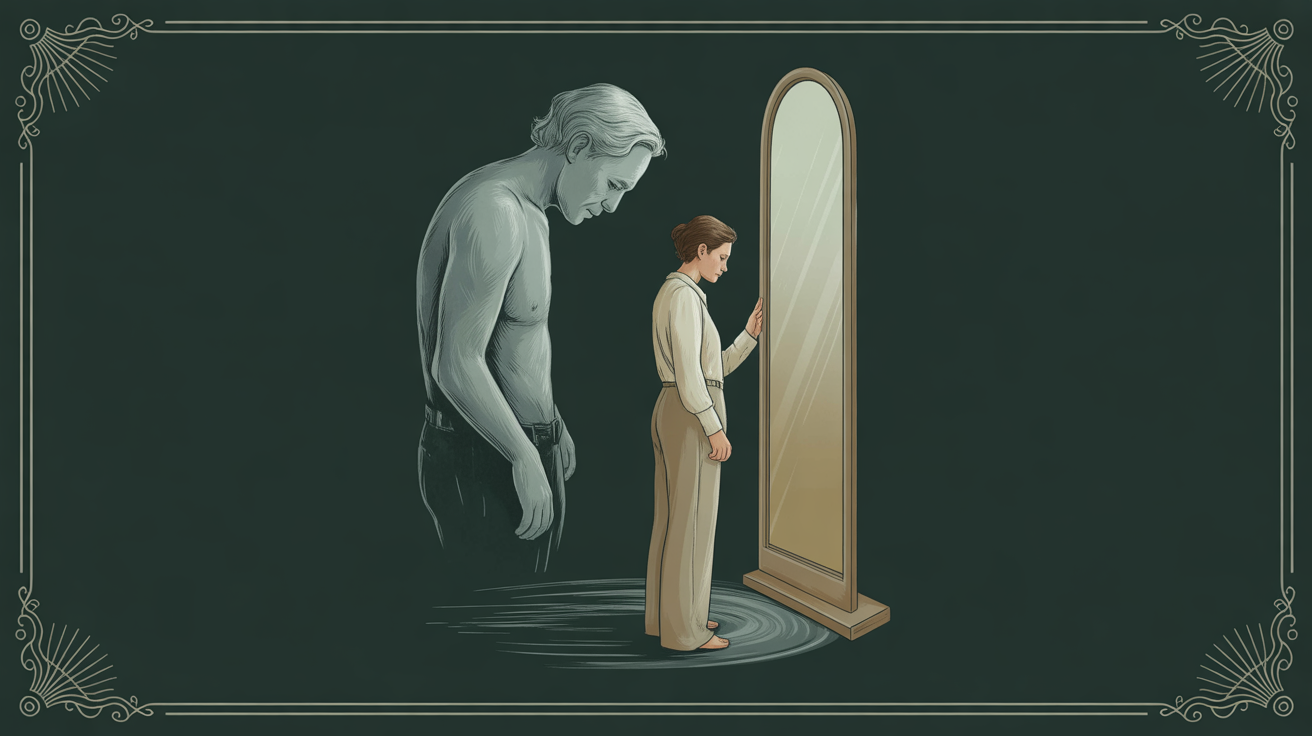
You know the new story. You’ve affirmed it, visualized it, maybe even felt calm and certain for a while. Then something small happens: a delayed text, an unexpected bill, a quiet day, one awkward conversation, and suddenly you’re back in the old version of yourself.
Not just thinking one negative thought, either. You feel like the old you again.
The one who is waiting. The one who is not chosen. The one who never gets ahead. The one who has to check, chase, prove, prepare, or protect themselves.
If you are searching for the old man Neville Goddard old story connection, you probably aren’t looking for theory only. You want to understand why the old self keeps feeling so convincing, even after you’ve decided to live in the end.
That’s the practical heart of this idea. The “old man” is not a mysterious enemy inside you. It is the familiar state of consciousness you have practiced, believed, defended, and returned to until it feels like reality. And “putting off” the old man is not about shaming yourself for having feelings. It is about noticing when you’ve become the old identity again, then gently withdrawing your consent from that state.
What “The Old Man” Means in Neville Goddard
In Neville Goddard’s teaching, the “old man” can be understood as the former self, the old state, or the identity you are leaving behind. Neville often interpreted biblical language psychologically and spiritually, so phrases about putting off the old self and putting on the new can be read as a shift in consciousness.
In simple terms:
The old man is the old identity.
The old story is the narrative that identity keeps telling.
The old reactions are the emotional and behavioral signs that the identity is active.
So, the old man is not merely “negative thinking.” That’s too shallow. You can repeat positive affirmations all day and still be identified with the one who is hoping, waiting, begging life to change, or trying to convince reality to finally choose you.
For example, someone might affirm, “I am loved,” but underneath, their identity is still, “I am the person who gets abandoned unless I work hard to keep people.” Another person might affirm, “Money flows to me,” while still living from the assumption, “I am always one step away from losing everything.”
That deeper position is the state.
In Neville’s framework, a state is not just a mood. It is a whole inner posture: what you assume about yourself, what you expect from life, what feels natural, what you notice, what you rehearse, and what you call “realistic.”
The old man says:
“This is who I am.”
“This is what happens to me.”
“This is how people treat me.”
“This is how life works.”
The new self says something different, not as a forced performance, but as a new inner home.
This is why the old man matters so much in manifestation and the law of assumption. If assumption is about who you are being, then the old man is the version of you who keeps assuming from the unwanted state.
Why You Keep Returning to the Old Story
Returning to the old story usually feels frustrating because it seems like you should know better by now. You’ve read the books, watched the videos, done the inner work, and still the old reaction shows up.
But the old story returns for very human reasons.
First, it is familiar.
The old state has history behind it. It has memories, emotional proof, past disappointments, family patterns, social evidence, and repeated inner conversations. When a circumstance appears to match it, your mind quickly says, “See? This is what I meant.”
That does not mean the old story is ultimately true. It means it has been rehearsed enough to feel true.
A delayed message becomes, “I’m being ignored again.”
A bill becomes, “I can never get ahead.”
One awkward moment becomes, “I always mess things up.”
A quiet period in your career becomes, “Nothing ever works for me.”
The trigger does not create the old man. It reveals which state is still easy to enter.
That distinction matters.
If someone doesn’t reply for six hours, the event itself is neutral until it gets interpreted. From one state, it means, “They’re busy. I’m fine.” From another state, it means, “I’m not important. I knew this would happen.” Same circumstance, different identity interpreting it.
Second, the old story often feels like “just being realistic.”
This is one of the sneakiest parts. The old man doesn’t always sound dramatic. Sometimes it sounds sensible.
“I know how this ends.”
“I’m just protecting myself.”
“I’m not being negative, I’m being honest.”
“People like me don’t get that.”
“I’ve seen this pattern before.”
Of course, discernment is valuable. Manifestation is not about denying real situations, ignoring red flags, or pretending practical issues don’t exist. But there is a difference between seeing a circumstance clearly and letting an old identity use that circumstance as final evidence against you.
The old story often presents itself as common sense because it has been practiced for so long.
Third, the old story can feel protective.
This part is important, and it’s often missed. Sometimes you return to the old man because the old identity gives you a sense of safety.
Expecting rejection can feel safer than assuming love because then you don’t feel caught off guard. Expecting money stress can feel safer than relaxing because then you feel prepared. Expecting disappointment can feel safer than receiving because receiving requires vulnerability.
The old self may not be happy, but it is familiar. And familiar can feel safe, even when it’s painful.
That’s why fighting the old man rarely works. If you attack the old self, you often create more tension. A gentler approach is more useful: “I see what this pattern is trying to do. It’s trying to protect me. But I don’t need to become it again.”
How to Recognize the Old Man in Real Time
Self-observation is not the same as policing every thought.
You do not need to anxiously monitor your mind all day, terrified that one doubtful sentence has ruined everything. That usually creates more fear, not more freedom.
Instead, learn to notice identification.
The question is not, “Did I just think the wrong thought?”
The better question is, “Who am I being right now?”
That one question cuts through a lot of confusion.
If you’re checking your phone every few minutes, who are you being?
If you’re mentally arguing with someone who isn’t there, who are you being?
If you’re telling a friend the same painful story again and again, who are you being?
If you’re looking at your bank account and deciding your whole future from that number, who are you being?
You’re not asking this to shame yourself. You’re asking so you can wake up inside the state.
Common signs the old man is active include:
- You mentally replay the same painful scene.
- You argue with someone in your imagination.
- You check for proof and feel worse afterward.
- You describe your desire as far away or unlikely.
- You interpret neutral events through rejection, lack, failure, or delay.
- You feel an urgent need to force, chase, fix, confess, or control from fear.
- You tell the same old story as if it is your permanent identity.
- You assume the worst and call it preparation.
Notice how ordinary these signs are. The old man is not always a huge emotional breakdown. Sometimes it’s a subtle inner sentence: “Here we go again.”
Ask: “Who Am I Being Right Now?”
This question brings the idea out of theory and into practice.
Here are a few examples:
“I am being the one who is waiting to be chosen.”
“I am being the one who expects money to disappear.”
“I am being the one who needs proof before feeling secure.”
“I am being the one who assumes good things don’t last.”
“I am being the one who has to earn love through anxiety.”
Once you name the state, you create space around it. You are no longer fully inside the old story. You are observing it.
That little bit of distance is powerful.
You might still feel the emotion. You might still feel fear in your body or disappointment in your chest. That’s okay. Feeling something does not automatically mean you have become the old man again.
The key is whether you give the old state authority.
Fear can be present while you remain anchored in a new assumption. Sadness can move through while you refuse to build an entire identity around it. A circumstance can be dealt with practically without becoming your definition of self.
Listen to Your Inner Conversation
Neville placed a lot of importance on inner speech, and for good reason. Your inner conversations reveal the state you’re occupying.
The old man often speaks in familiar phrases:
“Of course this happened.”
“I knew it was too good to be true.”
“They never choose me.”
“I can’t get ahead.”
“Nothing changes for me.”
“I always ruin things.”
“It’s too late.”
These thoughts may feel automatic, but they are not meaningless. They are the old story narrating life from the old identity.
Again, the goal is not self-punishment. You are not catching these phrases so you can scold yourself. You are catching them so you can stop unconsciously agreeing with them.
A useful response might be:
“That’s the old rejection story.”
“That’s the old lack story.”
“That’s the old version of me trying to predict the future from the past.”
Simple. Calm. No drama.
You don’t have to wrestle every thought to the ground. You just stop treating the old narration as the final word.
Putting Off the Old Man Without Fighting Yourself
Putting off the old man does not mean suppressing emotion, denying circumstances, or pretending nothing happened.
It means withdrawing identity from the old state.
You can acknowledge a situation and still refuse to become the person who is defeated by it. You can feel triggered and still decide not to narrate your entire future from that trigger. You can take practical action without acting from panic.
Here is a simple practice you can use in the moment.
First, pause and name the old story.
“This is the old rejection story.”
“This is the old lack story.”
“This is the old story that I’m behind.”
“This is the old belief that I have to chase to be safe.”
Naming it interrupts the automatic spell of it. Instead of “this is reality,” it becomes “this is a familiar state.”
Second, identify the state.
Ask, “Who am I being in this interpretation?”
Maybe the answer is:
“I am being the one who expects to lose.”
“I am being the one who waits for permission.”
“I am being the one who assumes silence means abandonment.”
“I am being the one who believes money is never enough.”
This step matters because it moves you from surface thought to identity.
Third, refuse to make it final.
You might say to yourself:
“This is familiar, but it is not my authority.”
“This is an old conclusion, not my final truth.”
“I can notice this without becoming it.”
That kind of sentence is often more useful than a giant affirmation you don’t believe. It creates a bridge. It helps you loosen your grip on the old state without forcing yourself into theatrical positivity.
Fourth, choose the new assumption.
The new story should feel inhabitable. It does not need to be exaggerated.
If your old story is, “I’m always abandoned,” jumping straight to “I am the most adored person in the universe” might feel too far away. If it works for you, fine. But if it creates inner strain, choose something steadier:
“I am learning to feel secure and chosen.”
“I do not need to chase for confirmation.”
“I can be calm before I have proof.”
“I am safe to receive love without earning it through anxiety.”
For money, the shift might be:
“I am learning to experience money as available.”
“I can respond to this bill from steadiness, not panic.”
“This number is information. It is not my identity.”
For confidence, it might be:
“One awkward moment does not define me.”
“I am allowed to grow without making every mistake mean something about my worth.”
“I can be the version of me who recovers quickly.”
Finally, let your next response come from the new self.
That could mean you stop checking. You wait before replying. You pay attention to one practical next step. You speak to yourself differently. You revise the inner conversation. You choose not to retell the old story to someone just to strengthen it.
This is persistence, but not in a harsh way.
Persistence means returning to the new identity again and again, not panicking every time the old one appears.
A Simple Self-Observation Exercise for the Old Story
Use this exercise when you feel pulled back into an old reaction. It’s especially helpful after a trigger, because it shows you the identity underneath the interpretation.
Write five lines:
1. What happened? Keep this factual and simple.
2. What did I immediately decide it meant about me? This reveals the old interpretation.
3. Who was I being in that interpretation? Name the old identity.
4. Who would I be if the wish fulfilled were natural? Name the new identity.
5. From that version of me, what does this mean now? Write one new inner sentence.
Example:
Trigger: They didn’t reply for six hours.
Old interpretation: I’m not important. They’re losing interest.
Old identity: The one who waits to be valued.
New identity: The one who is secure and chosen.
New inner sentence: I do not need to turn silence into rejection. I remain secure in who I am.
Here’s another example:
Trigger: I received an unexpected bill.
Old interpretation: I can never get ahead.
Old identity: The one who is always struggling.
New identity: The one who handles money with steadiness and increasing trust.
New inner sentence: This bill is something to respond to. It is not proof that I’m stuck forever.
This kind of practice trains you to see the old man as a state, not as your permanent self.
And that’s a huge shift.
The Old Man Loses Power When You Stop Becoming Him
The old man in Neville Goddard is not a monster to defeat. It is the old self-state that still tells the old story about who you are, what life is like, and what is possible for you.
You return to the old story because it is familiar, emotionally rehearsed, and often triggered by circumstances that seem to confirm it. But a trigger is not the final authority. It is an invitation to notice which version of you is being activated.
Putting off the old man is not about never feeling fear, never having a doubtful thought, or pretending the world in front of you does not exist. It is the practice of non-identification.
You notice the old story.
You name the state.
You stop treating it as truth.
You return to the new assumption.
That’s it. Not perfectly, not dramatically, and not with shame. Just repeatedly.
For the next 24 hours, don’t try to fix every thought. Simply notice the moments when you become the old identity. Ask, “Who am I being right now?” Then choose one inner sentence from the new self.
The old man loses power when you stop becoming him. The new story becomes natural the same way the old one did: through repeated occupation, gentle persistence, and the quiet decision to no longer let the past define who you are now.
