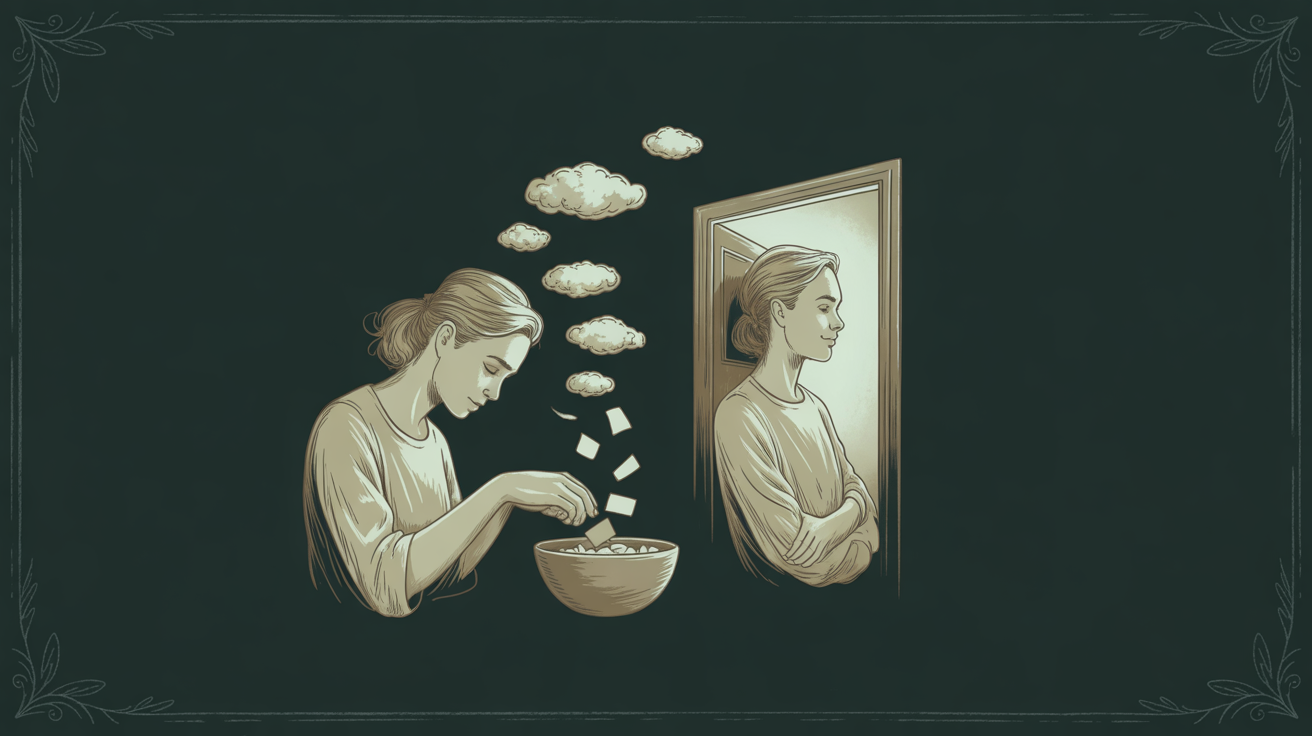
If you’ve spent any time around Neville Goddard or Law of Assumption content, you’ve probably heard two instructions over and over: keep a mental diet and live in the end.
At first, they can sound like the same thing. Aren’t you just supposed to think as if your desire is already done? And if so, does that mean you need to watch every thought, correct every doubt, and never have a bad day?
Not quite.
The difference between mental diet vs living in the end is simpler, and honestly, less stressful, than many people make it. A mental diet is about what you keep feeding your attention. Living in the end is about the identity or state you are choosing to occupy.
One cleans up the inner conversation. The other changes who you are assuming yourself to be.
The Short Answer: A Mental Diet Manages Attention, Living in the End Changes Identity
A mental diet is the practice of becoming more selective about the thoughts, assumptions, inner conversations, and stories you repeatedly accept as true.
Living in the end is the practice of identifying with the version of yourself for whom your desire is already natural, fulfilled, or inevitable.
So the two practices are related, but they are not interchangeable.
A mental diet asks:
“What am I repeatedly thinking, rehearsing, and agreeing with?”
Living in the end asks:
“Who am I being in relation to my desire?”
A mental diet helps you interrupt the old story. Living in the end helps you occupy the new state.
For example, if you are manifesting a healthier relationship, a mental diet might help you stop replaying rejection, imagining arguments, or telling yourself, “I’m never chosen.” Living in the end would go deeper. It would ask you to begin identifying as someone who is loved, respected, emotionally safe, and met with consistency.
The first practice works with mental content. The second works with inner position.
That distinction matters because a lot of people accidentally turn manifestation into mind surveillance. They think one anxious thought has ruined everything. It hasn’t. The issue is not every passing thought. The issue is the story you keep returning to, feeding, and treating like fact.
What a Mental Diet Actually Means
A mental diet in manifestation is not about becoming perfectly positive. It is not about suppressing fear, denying emotions, or panicking every time your mind says something unhelpful.
A better way to understand it is this:
A mental diet is the practice of noticing what you are mentally consuming and repeatedly agreeing with.
That includes:
- Inner conversations
- Rehearsed arguments
- Assumptions about yourself
- Assumptions about other people
- Imagined worst-case scenarios
- The meaning you attach to events
- The content you keep consuming if it reinforces fear or lack
The key word is repeatedly.
A random thought like, “What if this doesn’t work?” is not the same as spending three hours mentally building a case for why nothing ever works out for you. A passing doubt is not the same as choosing the old story and living inside it.
This is where a mental diet becomes useful. It helps you catch the loops that keep recreating the same inner state.
For example, say someone is manifesting more financial stability. A poor mental diet might look like this:
“I’m always behind. Money disappears as soon as I get it. I can never relax. Other people have support, but I don’t. Something bad always happens.”
If they repeat that story all day, check their account in panic, imagine bills going wrong, and consume content that reinforces helplessness, they are constantly feeding the identity of “I am unsupported and financially unsafe.”
A healthier mental diet does not require pretending everything is perfect. It might sound more like:
“I’m learning to handle money with more steadiness. I can make wise choices. I am becoming more supported and resourceful. This situation is not my identity.”
Notice that this is not fake euphoria. It is a deliberate shift in inner agreement.
The point is not to bully the mind into silence. It is to stop giving unlimited authority to thoughts that keep you locked in the old assumption.
A good mental diet feels firm, but not frantic. More like gently changing the channel, not screaming at yourself for having the wrong channel on in the first place.
What Living in the End Actually Means
Living in the end is one of the most misunderstood manifestation ideas because people often translate it as “act like you already have it.”
That can become awkward fast.
Living in the end does not mean pretending your bank account says something it doesn’t. It does not mean ignoring grief, bills, conflict, uncertainty, or practical responsibilities. It does not mean walking around performing confidence while you feel tense underneath.
Living in the end means assuming the wish fulfilled at the level of identity and inner reality.
In Neville Goddard terms, this is often connected to the idea of assuming the state of the wish fulfilled. Rather than staying identified as the person trying to get the thing, you begin returning to the inner state of the person for whom the desire is normal.
That word “normal” is important.
Living in the end often feels quieter than people expect. It may not feel like fireworks or constant excitement. Sometimes it feels like relief. Sometimes it feels like dignity. Sometimes it feels like, “Of course this belongs in my life,” without needing to argue for it every five minutes.
If your desire is a loving relationship, living in the end might mean you no longer identify as someone begging to be chosen. You begin relating to yourself as someone who is lovable, secure, wanted, and emotionally valued.
If your desire is career success, living in the end might mean you stop internally auditioning for worthiness. You begin identifying as someone whose work matters, whose skills are useful, and who can be seen and compensated well.
If your desire is money, living in the end does not mean spending recklessly or denying your current budget. It means beginning to identify as someone capable, supported, resourceful, and increasingly stable, then making decisions from that steadier state instead of pure panic.
Living in the end is not a performance for the outside world. It is the inner stance you return to.
The end is not always about knowing every detail of how something will happen. It is the fulfilled condition. The identity implied by the desire. The version of you who is no longer chasing, pleading, or mentally living in the absence of it.
Mental Diet vs Living in the End: The Practical Differences
The easiest way to understand mental diet vs living in the end is to compare what each one is actually doing.
1. Focus
A mental diet focuses on thoughts, inner conversations, reactions, and repeated assumptions.
Living in the end focuses on identity, state, and the felt reality of the wish fulfilled.
Mental diet is about the sentences running through your mind. Living in the end is about the self those sentences are coming from.
2. Purpose
A mental diet helps you stop feeding the old pattern.
Living in the end helps you inhabit the new pattern.
If your old pattern is “I’m always overlooked,” a mental diet helps you stop rehearsing that belief. Living in the end helps you become the person who naturally assumes, “I am seen, valued, and considered.”
3. Relationship to doubt
A mental diet says, “Notice the doubt, but don’t build a home inside it.”
Living in the end says, “Return to the version of you who is not defined by that doubt.”
This is a subtle but powerful difference. You don’t have to panic because doubt appeared. You also don’t have to make doubt your identity.
You can think, “Okay, an old fear came up,” and then return to the chosen state.
4. Emotional tone
A healthy mental diet feels like gentle discipline. You are paying attention to your inner world without attacking yourself for being human.
Living in the end feels more like alignment, relief, worthiness, or naturalness. Not necessarily intense joy. More like settling into the version of yourself who no longer needs to fight the old story all day.
5. Common distortion
A mental diet can become thought policing if you misunderstand it. This is when you start fearing your own mind and treating every intrusive or anxious thought like a manifestation emergency.
Living in the end can become pretending if you misunderstand it. This is when you ignore reality, force fake confidence, or use “it’s already done” to avoid practical action or emotional honesty.
Neither distortion is the real practice.
The real practice is calmer than that. You choose your state, notice what contradicts it, redirect without panic, and return again.
When a Mental Diet Helps Most
A mental diet is especially useful when you keep rehearsing the old story.
This might look like checking for proof that someone still cares, spiraling after a small delay, imagining rejection before it happens, mentally arguing with people, expecting disappointment, or turning every neutral event into bad evidence.
It also helps when your inner dialogue is full of absolutes like:
“Nothing works for me.”
“I always get abandoned.”
“Money never stays.”
“I’m behind everyone else.”
“I have to struggle to be chosen.”
A mental diet helps you stop treating those statements like truth. Not by panicking, but by refusing to keep feeding them.
You might replace “I’m always ignored” with “I am learning to expect respect and consistency.” You might replace “Money never stays” with “I am becoming someone who manages and receives money with more steadiness.”
The replacement doesn’t have to feel wildly magical. It just needs to point you back toward the state you are choosing.
When Living in the End Helps Most
Living in the end is most helpful when you are doing lots of techniques, but still feel like the person who does not have the desire.
You may be affirming, scripting, visualizing, and looking for signs, but underneath it all the identity is still, “I’m trying to get this because I don’t have it.”
That’s when the deeper question is not, “What phrase should I repeat?” It is:
“Who would I be if this were already natural for me?”
For love, that might be someone who feels chosen and secure.
For money, someone capable and supported.
For success, someone whose work is valuable and recognized.
For confidence, someone who does not constantly ask permission to exist.
Living in the end helps you move from technique-hopping into identity. The technique can support the state, but it is not the state itself.
How to Use Both Without Becoming Obsessive
You don’t have to choose between a mental diet and living in the end. Used well, they support each other beautifully.
The trick is to use them with calm consistency, not fear.
Here’s a simple way to combine them.
1. Name the end state
Choose one desire and identify the identity implied by its fulfillment.
For example:
“I am someone who is loved consistently.”
“I am someone who handles money with confidence.”
“I am someone whose work is valued.”
“I am someone who is safe being seen.”
Keep it simple. You’re not writing a whole life script right now, just naming the state.
2. Notice the old mental diet
For one day, pay attention to the recurring inner story that contradicts that state.
Don’t shame yourself for it. Just notice.
Maybe the old story is, “I have to prove myself.” Maybe it’s, “People always leave.” Maybe it’s, “I can’t trust good things.” Maybe it’s, “I’m not the kind of person this happens for.”
That is the mental diet you’ve been living on.
3. Redirect the thought without panic
When the old inner conversation starts, gently interrupt it.
Not with force. Not with fear. Just a steady refusal to keep rehearsing what you no longer want to identify with.
For instance:
Old loop: “They’re pulling away. I knew this would happen.”
Redirect: “I don’t need to assume abandonment. I am someone who is met with clarity and consistency.”
Old loop: “I’m terrible with money.”
Redirect: “I am learning to handle money with more confidence and care.”
Old loop: “No one sees my value.”
Redirect: “My value is real, and I am becoming more available to being recognized for it.”
4. Return to identity
After redirecting the thought, don’t stay stuck in mental correction mode. Come back to the bigger question:
“If I were already becoming this version of myself, how would I speak to myself right now?”
“What would I stop rehearsing?”
“What would feel natural for me to assume?”
This is where living in the end becomes the anchor. The mental diet clears the noise, but the identity gives you somewhere to land.
And if the practice starts making you tense, afraid of your own thoughts, or responsible for controlling every emotion, pause. That’s not alignment. That’s pressure wearing a spiritual costume.
You are allowed to have human feelings. You are allowed to have an off day. You are allowed to notice fear without making it the final truth about you.
The Takeaway: One Cleans Up the Inner Conversation, the Other Chooses the Self
A mental diet and living in the end are connected, but they are not the same.
A mental diet helps you stop repeatedly agreeing with thoughts that reinforce the old identity. It asks you to become conscious of what you are feeding with attention, repetition, and emotional agreement.
Living in the end helps you identify with the fulfilled version of yourself. It asks you to move from “I am trying to get this” into “I am becoming the person for whom this is natural.”
So, no, you do not need to monitor every thought perfectly. And no, living in the end does not mean pretending real life doesn’t exist.
The grounded practice is returning. Returning from the old story. Returning from panic. Returning from mental arguments. Returning to the state you want to normalize.
For a simple next step, choose one desire and write down the identity implied by its fulfillment. Then, for one day, notice which inner conversations support that identity and which ones pull you back into the old one.
That’s the bridge between the two: use your mental diet to stop feeding the old self, and use living in the end to choose the self you are becoming.
