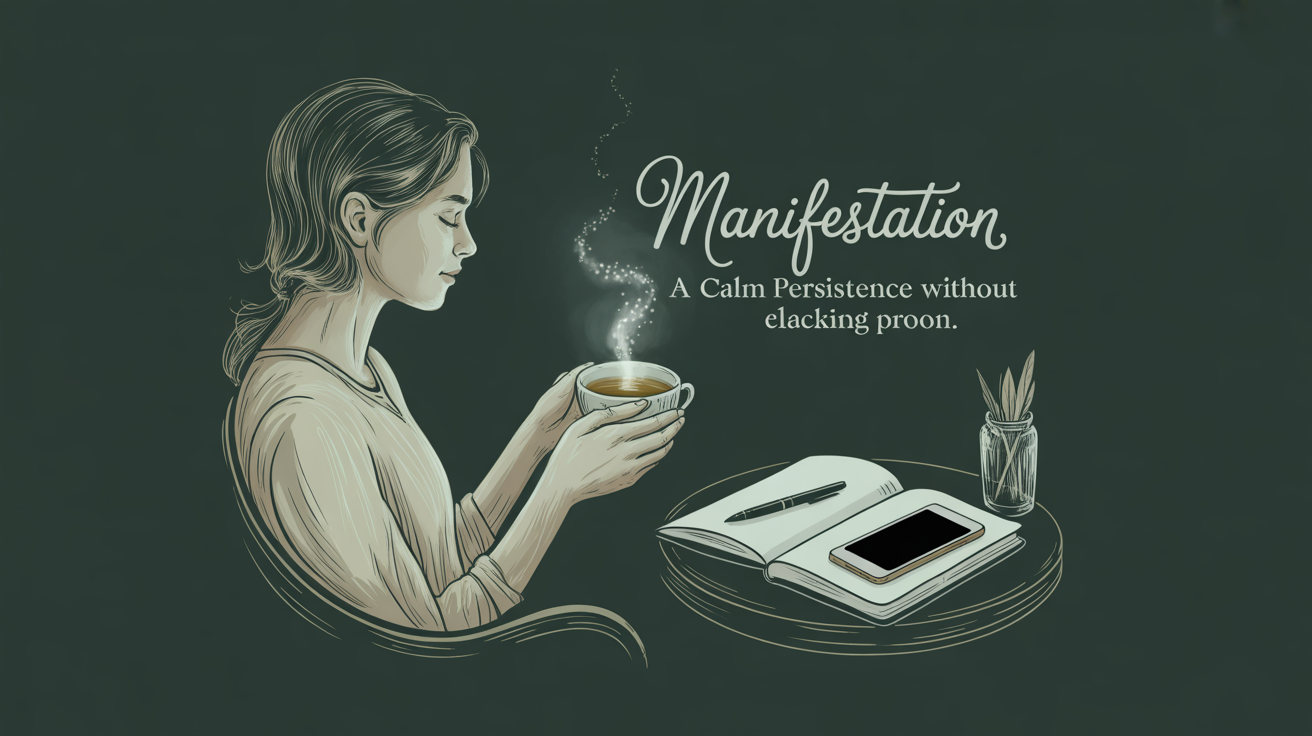
Trying to persist can get exhausting when it turns into a full-time mental job. You affirm, then check. You visualize, then wonder if you felt it correctly. You decide to trust, then look for proof five minutes later.
If you’re trying to persist without forcing checking or obsessing, the first thing to understand is this: persistence is not pressure. It is not monitoring every thought, fighting every doubt, or pretending you’re totally calm when you’re not.
In the law of assumption, persistence is a return. You return to the identity, expectation, and inner story you have chosen, even when your mood or circumstances wobble. That’s it. Not perfectly. Not dramatically. Just consistently enough that the old story stops being your automatic home.
What It Really Means To Persist In An Assumption
To persist in an assumption means you keep choosing the inner position that matches your desired reality.
It does not mean you think about the desire every second. It does not mean you must feel euphoric all day. And it definitely does not mean you have failed if you have a doubtful thought.
In Neville Goddard’s teaching, the idea of persistence is closely connected to occupying the wish fulfilled: identifying with the version of you for whom the desire is already natural. In practical terms, that means you stop treating the desire as a distant problem you have to chase, and you begin relating to it as something that belongs in your life.
That can feel surprisingly ordinary.
A fulfilled state is often not loud. It can feel like, “Of course this is working out for me,” or, “This is becoming normal now.” It is more stable than frantic. More settled than excited. More like coming home than trying to make something happen by force.
You can still want the thing. Wanting does not automatically mean you are “out of the state.” The issue is not desire itself. The issue is letting every passing feeling, delay, or circumstance rewrite your whole identity.
Persistence means:
- You notice the old fear without making it the final truth.
- You return to the assumption you chose.
- You let the new story become more familiar through repetition.
- You stop asking every mood to prove whether your manifestation is working.
Think of it less as performing belief and more as practicing loyalty to a new inner direction.
The Difference Between Persisting And Forcing
Forcing usually begins when you try to manufacture certainty right now.
You may repeat affirmations aggressively because you feel panicked. You may visualize while secretly thinking, “If I do this hard enough, maybe it’ll finally happen.” You may monitor every thought and treat doubt like an emergency that must be fixed immediately.
That is not persistence. That is fear wearing a manifestation costume.
Forcing often sounds like:
- “Why isn’t it here yet?”
- “I need to affirm harder.”
- “If I stop thinking about it, I’ll lose it.”
- “This doubt ruined everything.”
- “I need a sign now or I can’t relax.”
Persisting sounds different:
- “I noticed the fear.”
- “I still know what I am choosing.”
- “I don’t need to solve this from panic.”
- “The old story is not my final answer.”
- “I can return without forcing.”
The difference is not always visible from the outside. Two people might both repeat the same affirmation, but one is using it as a gentle reminder while the other is using it to fight desperation.
A good practice should leave you more centered, even if only slightly. If your practice leaves you more frantic, more obsessed, or more convinced that you did it wrong, it may be time to soften your approach.
Persisting feels like returning to a chosen position. Forcing feels like wrestling with the absence of the desire.
That distinction matters.
A Calmer Way To Persist Without Forcing, Checking, Or Obsessing
You do not need a complicated routine. In fact, the more anxious you feel, the simpler your practice should be. Here is a practical way to persist in the assumption without turning it into another thing to obsess over.
1. Define the version of you who already has it
Instead of asking, “How do I get this?” ask, “Who am I when this is normal for me?”
This moves you from chasing to identity.
Try these prompts:
- How would I speak to myself if this were already handled?
- What would I stop over-explaining or proving?
- What would feel normal in my day if this desire were part of my life?
- What is the simple assumption I am returning to?
Your assumption does not need to be dramatic. Actually, it’s often better if it feels simple enough to practice.
Examples:
- “I am someone who is chosen and respected.”
- “Money is becoming easier for me to receive and manage.”
- “My life is moving in a favorable direction.”
- “This is unfolding, even if I cannot see every step.”
- “I am becoming secure in what I choose.”
Choose one assumption that feels steady, not performative. You are not trying to impress your mind. You are giving it a new place to land.
2. Use a light-touch return phrase
A return phrase is not a magic sentence. It is not something you must repeat 500 times to “make” reality change.
It is a simple phrase that interrupts the spiral and brings you back to your chosen state.
Try one of these:
- “I do not need to solve this from panic.”
- “I know what I am choosing.”
- “The old story is not my final answer.”
- “I can return without forcing.”
- “It is safe to let this be handled.”
- “I don’t need to check to trust.”
Use it once or a few times, then move on with your day. The goal is not to create a new compulsion. The goal is to stop feeding the loop.
If you notice yourself repeating the phrase in a tense, urgent way, pause. Take a breath. Remind yourself: “This is a return, not a ritual I have to perfect.”
3. Stop using the 3D as a permission slip
In manifestation spaces, “the 3D” usually means the visible physical world: current circumstances, messages, money, timing, other people’s behavior, and what your senses are showing you.
Checking the 3D is not always bad. You may need to check your bank account, answer a message, look at a deadline, or handle a real responsibility. Practical checking is part of life.
Compulsive checking is different.
Compulsive checking is when you keep looking at reality to decide whether you are allowed to feel secure yet.
It sounds like:
- “Did they view my story?”
- “Has the money arrived?”
- “Did anything change?”
- “Was that a sign?”
- “Can I believe now?”
The problem is not that you looked once. The problem is making the outside world your emotional scoreboard.
Persistence asks you to decide internally first. Not in a delusional way. Not by ignoring responsibilities. But by refusing to let every temporary circumstance become your identity.
Helpful boundaries:
- Check what genuinely needs checking once, then stop refreshing.
- Avoid creating tests like, “If it happens by 5 p.m., it’s working.”
- Do not turn signs into emotional verdicts.
- After handling reality, return to your assumption instead of analyzing it for an hour.
You can respond to life without letting life tell you who you are.
4. Let doubt pass without making it a new story
Doubt does not have to become a crisis.
A doubtful thought is a mental event. A feeling of fear is an emotional event. Neither one has to become your new assumption.
Instead of arguing with doubt, try this:
1. Notice: “I am having a doubtful thought.” 2. Normalize: “This is an old pattern trying to protect me.” 3. Return: “I still choose the assumption I decided on.” 4. Continue: Do the next ordinary thing in your day.
For example, if your mind says, “It’s not working,” you might respond:
“That is the old conclusion. I do not need to agree with it. I return to the version of me who is secure.”
Then make tea. Send the email. Fold the laundry. Go for a walk. Do something normal.
This part is underrated. Obsession thrives when your whole day becomes a reaction to the desire. A fulfilled identity has a life. It does not sit in mental surveillance 24/7.
What To Do When There Is No Visible Movement
The hardest moment is usually not during a meditation or scripting session. It is when you see no text, no money, no change, no apology, no opportunity, no visible movement.
That is when the old story gets loud.
No visible movement does not have to become a new identity. Absence of evidence is not automatically evidence of failure. It is simply what you can currently see.
This does not mean ignoring practical reality. If a bill needs to be paid, look at it. If a relationship needs boundaries, honor that. If you need to apply for jobs, make a budget, have an honest conversation, or seek support, that can coexist with manifestation.
The key is not emotionally crowning the current circumstance as final.
Use this trigger-moment script:
1. Pause before reacting. 2. Name what is happening: “I am checking for proof.” 3. Put the circumstance in its place: “This is information, not my identity.” 4. Return to the assumption: “I am still the version of me for whom this works out.” 5. Take one grounded action if needed, then move on.
If your feelings are intense, regulate first. Breathe. Step away from your phone. Get your body out of the panic loop before trying to affirm. You don’t have to paste affirmations over distress and pretend it’s fine.
If anxiety feels overwhelming or starts interfering with daily life, it’s okay to get support from a qualified professional. Manifestation practice should not require you to struggle alone.
A Simple Daily Practice For Calm Persistence
Keep this light. The point is to train return, not to create a manifestation checklist that makes you nervous.
Try this for the next three days.
Morning: choose one assumption.
Example: “I am becoming someone who is secure in what I choose.”
During the day: use one return phrase when triggered.
Example: “I do not need to check to trust.”
Evening: briefly notice where you returned instead of spiraled.
Example: “Today I wanted to check, but I paused. I returned. That counts.”
Optional: write one sentence from the fulfilled identity.
Example: “I am proud of how natural this is becoming for me.”
That is enough.
You do not need hours of affirming. You do not need endless visualization. You do not need to prove your belief every few minutes. Calm persistence is built through small returns repeated over time.
Measure progress by recovery time, not by zero doubt.
If you used to spiral for three hours and now you return after twenty minutes, that matters. If you checked ten times yesterday and only three times today, that matters. If you reacted, then caught yourself with compassion instead of shame, that matters too.
Persistence should make you more stable, not more desperate.
Final Takeaway
To persist is not to cling. It is not forcing the desire into being with mental pressure. It is continuing to identify with the desired reality while treating doubts, delays, and circumstances as temporary experiences rather than final truth.
You are allowed to care. You are allowed to have human feelings. You are allowed to notice reality and still not make it the author of your identity.
For the next three days, keep it simple:
Pick one assumption. Pick one return phrase. Practice returning without checking for proof every time.
That is real persistence: not obsession, not denial, not panic dressed up as devotion, but a gentle, repeated return to the version of you for whom the desire is natural.
